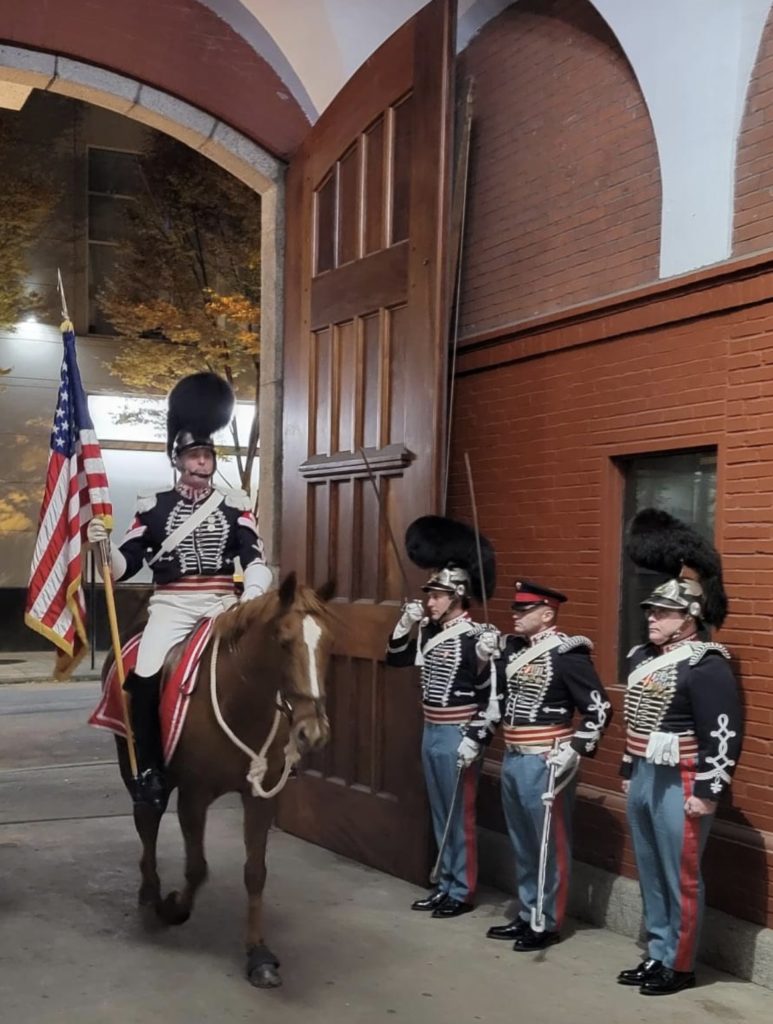
The
First Continental Congress met in September 1774,
in the Hall of Carpenters' Company, Philadelphia.
A Committee of Correspondence was elected by the
citizens of Philadelphia to determine the most effective
means of resisting the British and to carry out
the nonimportation resolutions of the Congress.
The Committee first met on the afternoon of Thursday,
November 17, 1774, in the Pennsylvania State House.
That evening three of the members, together with
twenty-five other gentlemen, gathered according
to tradition in Carpenters' Hall and associated
as the Light Horse of the City of Philadelphia,
a name that was later changed to First Troop Philadelphia
City Cavalry.
This purely volunteer cavalry
troop was the first organized in defense of the
colonies. Today the Troop is certainly the oldest
mounted military unit and quite possibly the oldest
military unit of any kind that has been in continuous
service to the Republic. The times that called
it into being, and the character of the original
members who fought through the seven years of
the American Revolution, together forged concepts
of service and a body of tradition that have given
it a continuity of purpose for more than 225 years.
The
gentlemen of the Philadelphia Light Horse were
professional men, shipowners, importers, or traders,
generally of conspicuous prominence in the affairs
of the day. The membership was not to confine
itself to public or civil life, for many were
to hold commissions in the Continental service
and in the Army and Navy of the State. The Rolls
of the Troop ever since have been enriched by
outstanding individual records in all branches
of military life.
A number of social organizations
played an important part in forming the new cavalry
unit. The oldest of these was the Schuylkill Fishing
Company, a club that numbered many Troopers among
its officers. Other organizations from which the
Light Horse drew its members were the Schuylkill
Company of Fort St. Davids, the St. Andrew's Society
of Philadelphia, the Society of the Friendly Sons
of St. Patrick, and the Society of the Sons of
St. George. The Gloucester Fox Hunting Club had
especial influence. The "round black hat
bound with silver cord and buck's tail" and
the dark brown short coat faced and lined with
white worn by the Trooper of the Revolution were
similar to the hunting coat and cap in which its
club members rode to hounds. Captain Samuel Morris
was Gloucester's first president and Captain Robert
Wharton its last, and twenty-five Troopers were
among its members during the War.
The associates who met on the
evening of November 17, 1774, voted to equip and
support themselves at their own expense and to
offer their services to the Continental Congress.
The company prepared for active duty by holding
drills at five in the morning and five in the
afternoon several times a week.
Abraham
Markoe, a Danish subject, was chosen to be the
first Captain because of his energy in organizing
the Troop and his previous Danish military experience.
Though prevented from open participation in the
War as a result of the Neutrality Edict issued
by then King Christian II of Denmark, Captain
Markoe took an active part in the defeat of the
enemy by all other available means.
At the time there was no common
flag in use by any of the colonies. Not long after
the news of the Battle of Lexington reached Philadelphia,
Captain Markoe presented the Troop with the Standard
that was to be carried in the battles of Trenton,
Princeton, Brandywine, and Germantown, and on
all parades until about 1830, when it was retired
for safekeeping.
When George Washington was appointed
Commander in Chief of the Continental Army in
June of 1775, the Troop assumed varied duties.
Close personal contact with the General developed
as he was escorted to distant points in the Colonies.
The command was frequently called upon to provide
detachments to accompany prisoners and spies,
to bear dispatches for the Committee of Safety,
and to march with money for delivery to the Army.
TRENTON
(26 DEC 1776)
With
Captain Samuel Morris at its head, the Philadelphia
Light Horse reported to General Washington in
late 1776. The Troop covered the rear of the Continental
Army as it retreated across the Delaware pursued
by Lord Cornwallis and his British and Hessian
troops. On Christmas night, 1776, the Troop recrossed
the Delaware with the Continental Army. The craft
in which the Troop embarked could not reach shore
and the cavalrymen were forced to take to the
water and make their way with their horses through
the darkness and floating ice.
Approaching Trenton at dawn, the
Troop rode near Washington in the column under
Major General Nathaniel Greene. During the Battle
of Trenton, the Troop served as escort to General
Washington and his staff. A detachment of the
Troop captured a body of Hessians fortified in
a barn during a fierce engagement. The battle
lasted forty-five minutes with the capture of
about a thousand Hessians and the loss of two
Americans. The Troop served as the Army's rearguard
as it recrossed the Delaware, patrolling the roads
until dark. A statue of a Trooper serves as the
Trenton Battle Monument to this day.
PRINCETON (3
JAN 1777)
Trenton was reoccupied on December
30. The Troop performed critical reconnaissance
the next day. Twelve Troopers under Colonel Joseph
Reed, the Adjutant General, captured eleven dragoons
within sight of the enemy's main army. As Lord
Cornwallis occupied the lines across from Trenton,
Washington slipped the Army out at night and marched
on Princeton. Units of Pennsylvania Militia, the
rear of the Continental Army, were panicked and
routed by fifty British dragoons during the night
march. The dragoons then encountered twenty-two
Troopers aligned abreast blocking the road. After
consideration the dragoons withdrew and the Troop
marched on Princeton.
During the climax of the Battle
of Princeton, General Washington, with many Troopers
by his side, led the counterattack against the
British. The Troop charged in "the fine Fox-chase"
and the Army routed three British regiments that
day. General Washington withdrew the Army to Morristown
before Cornwallis could bring up his superior
forces. The successful rear guard action by the
Troop saved the artillery train. "The ten
days that changed the world" were over. It
would be four long years until Cornwallis surrendered
at Yorktown but the Republic would prevail. General
Washington relieved the Troop on January 23rd
and they returned to Philadelphia.
BRANDYWINE (11 SEPT 1777) - GERMANTOWN
(4 OCT 1777) - VALLEY FORGE
After its return to Philadelphia
the Troop engaged in months of arduous service.
The Troop served under Maxwell's command at the
Battle of Brandywine and assisted in maintaining
communications during the unsuccessful Battle
of Germantown. The Troop served as detachments
during the winter at Valley Forge. One group narrowly
escaped capture with General Lafayette and his
small force when they were nearly surrounded in
the woods at Barren Hill. When the British withdrew
from Philadelphia, the first troops to reenter
the city were the Philadelphia Light Horse with
the city's new commander, the hero of Saratoga,
Major General Benedict Arnold.
The Troop suppressed a serious
riot in Philadelphia in October 1779. Troopers
subscribed over one-quarter of the £300,000
to organize a bank in 1780. In January 1781, the
Troop assisted Generals Lafayette and St. Clair
in suppressing a mutiny and administering its
amnesty.
Yorktown
surrendered on October 19, 1781 and the captured
standards were placed in the care of the Troop.
Eighty-three Troopers, including Honorary Captain
Markoe, led a parade through the streets of Philadelphia
to the State House and surrendered the trophies
to Congress. At the cessation of hostilities on
April 11, 1783, the Troop enrollment was eighty-eight
members.
Following Washington's death on
December 14th, 1799, the Troop participated in
the funeral pageant and paraded, dismounted, assembling
"in compleat uniforms at the State House
for the purpose of paying the sad tribute of veneration
to the remains of their late Commander in Chief."
On March 30, 1811, a law was passed
authorizing a regimental organization of the cavalry;
existing troops were to retain their respective
uniforms. The provisions of this law were accepted
by the officers of the several units of the city
and county of Philadelphia. Troop Captain Robert
Wharton was elected Colonel of the Regiment's
combined troops.
THE "WAR
OF 1812" WITH GREAT BRITAIN
The
differences that existed following the War of
Independance between the United States and Great
Britain resulted in a declaration of war by Congress
on June 18, 1812, and four days later the regiment
of cavalry offered its services to the Government.
During 1812 and 1813 the Troop drilled several
time a month.
On August 25, 1814, news came
of the Battle of Bladensburg and the capture of
the city of Washington. A requisition was made
on Pennsylvania for fourteen thousand men. The
Troop under Captain Charles Ross tendered its
services on August 27th and was ordered to act
as vedettes on the line between the Delaware River
and the Chesapeake Bay, protecting Philadelphia
from the expected advance of the British forces
north from Washington.
On September 11th eight ships
were seen heading for Baltimore, and on September
13th the firing of heavy guns was reported. The
enemy was repulsed on September 15th. That day
the Troop received an order from the Committee
of Defense in Philadelphia to establish an extra
line of scouts to Baltimore to bring intelligence
of the movements of the enemy's ships in the bay.
Former Brigadier General Robert Wharton, who had
been Captain of the Troop from 1803 to 1811, was
serving once again with the Troop for the campaign
as a private Trooper. He was taking his scheduled
turn as one of the Troop's cooks when news reached
him, on October 16th, the he was being called
back to the city to serve for the fourth time
as the Mayor of Philadelphia. By December 7th,
1814, the threat to the City of Philadelphia had
passed. The camp at Mount Bull was struck and
on December 12th the Troop was discharged from
service in the campaign.
By the time, on November 17th,
1824, that the Troop celebrated its 50th anniversary
with a dinner at the Franklin House, the Troop
had seen much action both in the defense of the
colonies against foreign threats and in recurrent
duty to suppress civilian unrest and insurrection.
It had become increasingly clear that the organization
would carry on in the less spectacular times of
peace as well. Conforming to drill regularions
and the expanding militia's requirements, it proved
itself ready on numerous occasions to serve either
the Commonwealth or the Nation. It had set standards
that influenced and encouraged the growth of similar
units. Many members helped to organize or served
in military organizations of a like natuire. In
civilian and pubic life the membership carried
on the traditions begun by the Troop's founders.
By-laws and uniform regulations were adopted and
closely attended to. The claim of the Troop that
it take the right of the line in all parades was
legally established in the Militia Act of April
2, 1821. Efforts were made to record the organization's
early history, and the "Donnaldson Narrative"
was prepared and original documents filed for
preservation in the archives. In the autumn of
1826, the copper plate still used today for the
printing of membership certificates was engraved
by Cephas A. Childs and first put to use. November
17th -- the anniversary of George Washington's
birthday -- had long since been defined as "the
day we celebrate," and the Sunday nearest
the anniversary of Washington's death had become
the occasion of an annual church service. The
dinner celebrations were held in rented halls
(the Troop possessing no permanent facilities
at the time) and the services were traditionally
held at St. Peters on Pine Street or Christ's
Church on Second Street -- places where founding
Troopers often worshiped with General Washington
during and after winning of the Nation's independence.
The fifteen years under Captain William H. Hart,
1827 to 1842, were to see these ceremonies mellow
into traditions which are still upheld today,
while at the same time, the pattern of the organization's
military duties became even more clearly defined.
THE WAR WITH
MEXICO
The
Republic of Mexico declared war agains the United
States on June 4th, 1845, but hostilities did
not begin until the following spring, when a proclamation
of a state of war was issued by President Polk.
Although there was no call for cavalry, Captain
John Butler raised a volunteer company of dragoons
in Philadelphia for the regular United States
Service that served in the Mexican Campaign. Several
individual members of the Troop served with distinction
during the campaign.
FIRST FACILITIES
An armory of sorts was established
in 1853 by the renting and furnishing of a front
room on the third floor of a building at Eighth
and Chestnut Streets. Up to this time, there had
been no permanentl meeting place for the Troop.
Business meetiings had been held in the "Captain's
quarters," or in rooms hired in various hotels
and taverns. Some were held "in the saddle"
and a number at the "castle" on the
grounds of the State in Schuylkill. It was not
until 1863 that the Troop was to build its first
permanent armory at Twenty-first and Ludlow Streets
(then Ash Street).
THE CIVIL WAR
- 1861-1864
The drift of political affairs
in 1861 made it evident that the Troop might be
called into active service. When the call for
volunteers was made by the federal government
on April 15th 1861, the Troop at once tendered
its services. As a unit, First City Troop was
the only volunteer cavalry organization accepted
under President Lincoln's first ninety-day call
up of state militia units. Ultimately, First City
Troop played an integral part in the Civil War,
both as a Pennsylvania militia unit and by the
actions of individual First City Troopers serving
with other units. The impact of their involvement
was deep and far-reaching.
In
accordance with time-honored custom, Divine Service
was attended at St. Peter's Church on the Sunday
preceding departure for active duty and on May
13th, 1861, the Troop was mustered into service
for ninety days. Each man was equipped at his
own expense with the uniform of the United States
Dragoons. The War Department agreed to supply
arms, horse furniture and camp equipage, but horses
and many other necessities were unavailable from
Washington. To meet these needs, $4,050 was contributed
by members and friends of the unit.
The unit left on May 30th to join
the 2nd U.S. Cavalry at Carlisle. and by June
7th it had reached Williamsport on the Potomac.
The Troop led the main body across the river to
Falling Water, VA. On reconnaisance the following
day, the Troop encountered a small body of mounted
Confederates who retreated without offering resistance.
After a day of uneventful maneuvering, the Troop
was again near Falling Water, when skirmishers
on the front and right flank became engaged with
the enemy. The forces of the Confederacy on that
field were infantry commanded by Colonel "Stonewall"
Jackson and cavalry commanded by Colonel J.E.B.
Stuart. On the Union side the First Wisconsin,
Eleventh Pennsylvania Rangers, McMullin's Rangers,
Perkins' Battery and the First City Troop were
brought to bear.
As the battle was joined, the
Troop was hurried to the top of a hill in support
of one section of Perkins' Battery. There a brisk
fire was opened upon the enemy. Although the encounter
was brief and losses not heavy on either side,
it was the first engagement of the Civil War in
which troops had been used in any numbers in a
systematic manner. Colonel J.J. Abercrombie, the
brigade commander, wrote: "Captain Hudson's
second Light Battery and the City Troop under
Captain (Thomas C.) James aided materially in
driving the enemy from the field."
Following this first battle, the
Troop saw duty at Bunker Hill, Charlestown, Harper's
Ferry, Key's Ferry and Sandy Hook, Maryland, as
well as keeping pickets on the south side of the
Potomac. Upon the expiration of its three month's
service the organization was ordered home. It
was complimented in orders by its Commanding General
and Colonel George H. Thomas, who commanded the
Brigade, as well as by General Robert Patterson.
In retrospect, as a "school for cavalry officers,"
the Battle of Falling Water was invaluable. As
the war increased in scope and ferocity, many
additional cavalry units would be formed for federal
service. Ultimately, forty-nine members of the
Active Roll of April 15, 1861, as well as eight
members of the Honorary and Non-Active Rolls,
would serve as officers in these new federal units.
After federal service was complete,
the Troop returned to Philadelphia and mustered
out on August 17th, 1861. Many members of the
Troop subsequently volunteered to join the Union
Army. Concurrently, the Troop recruited new members
to fill the vacancies of those marching off to
battle in federal ranks. The Troop -- as a unit
-- would continue its traditions and its service
to the Commonwealth throughout the war.
In early May of 1862 the Troop
offered its services to protect the City of Washington
which again appeared to be in peril. Before the
Troop's offer could be accepted, however, the
Confederate forces fell back. The subsequent disasterous
campaign of the Virginia Peninsula caused alarm
in the North and the Troop met daily to recruit
and to train new members. In September, when the
Confederate Army had crossed the Potomac and encamped
at Frederick, the Troop planned to organize a
cavalry regiment which would by officered by its
current members. A large storeroom was rented
as a recruiting station, and five hundred men
were promptly enlisted. The project had to be
abandoned however, because at this stage in the
war, horses and other requisite equipment were
unavailable from the state and difficult to procure
in such numbers on the civilian economy.
On April 4th, 1863, The Governor
of Pennsylvania signed the Act of Incorporation
of the First Troop Philadelphia Cavalry, which
had previously been approved by the State Legislature.
GETTYSBURG
On
June 15th, 1863, following the advance of the
Confederate Army into the Cumberland Valley, President
Lincoln called out 50,000 militia. At this stage,
most members of First Troop Philadelphia City
Cavalry were serving with other federal units
or had already become casualties of the war. The
thirty one remaining members organized under Cornet
Samuel J. Randall, furnished themselves with horses
and equipment, and rode for Harrisburg, arriving
there on June 19th. They were immediately accepted
into service without swearing in and ordered to
Gettysburg. At 4:00 AM on the 21st of June, the
Troop was the first military unit to arrive on
the scene of what was about to become the pivotal
battle of the Cival War. The residents of Gettysburg,
relieved to see Union soldiers, were extremely
generous to the Troop, then and throughout the
campaign. Given the paucity of the Troop's commissary
supplies, this generousity was greatly appreciated
and long remembered.
At Gerrysburg, Cornet Randall
reported to Major Granville O. Haller. In that
no one was certain where General Lee and his vast
force might be, Cornet Randall was immediately
ordered to take a detail of ten men to reconnoiter
the Chambersburg Turnpike toward Cashtown. There
they captured two Confederate soldiers who were
sent to the rear under the escort of three Troopers.
The reconnaissance established the presence of
Jenkins' Brigade of Stuart's Cavalry Corps, operating
between Williamsport and Chambersburg, which was
military intelligence of significant import at
this preliminary stage of the battle.
The same afternoon, in response
to rumors of a force approaching Fairfield, the
remainder of the Troop was ordered out to reconnoiter,
accompanied by Major Haller and Captain Bell with
an additional squad of cavalry which had arrived.
Just east of Fairfield they observed about one
hundred and sixty Confederate mounted infantry
scouting the countryside for forage and remounts.
The main Confederate body was stationed on the
outsikirts of the town while detachments were
sent out in various directions. Major Haller left
Captain Bell and his cavalry squad in place and
cautiously led the First City Troopers to within
a half mile of the town. From that point he ordered
a charge that swept through the town, driving
the enemy back to a nearby mountain pass.
For the next few days the Troop
was employed on patrols covering roads leading
in the direction of the enemy. Split into three
detachments on June 25th, the Troop continued
to live in the saddle, observing and reporting
on the enemy's movements. Shots were frequently
exchanged on these missions as Troopers swung
close to ememy formations or galloped in even
closer in quest of prisoners needed for intelligence
purposes.
In one instance, operating together
on a mission to York, the entire Troop was nearly
enveloped, narrowly escaping capture by riding
long and hard. The Troop reached York so covered
with mud and grime as to be unrecognizable as
either Union or Confederate. From York the Troop
moved to Wrightsville and from there across the
Susquehanna to Columbia, where it spent the night.
The next day it recrossed to observe the enemy
advancing in force under General John B. Gordon.
A formation of recently raised militia infantry,
operating in that area, was engaged by Gordon's
force. Many of the Union militia were quickly
enveloped and captured by the battle-hardened
Confederate regulars. The Troop's efforts were
essential in preserving order among the many others
who were near panic, particularly as the last
of these companies approached the bridge over
the Susquehanna with Gordon's infantry hot on
their heels. The military authorities on the scene
determined to destroy the bridge which, with it's
twenty-one spans across the Susquehanna, was more
than a mile long. Four Troopers detailed under
the supervision of Major Knox of the 9th New York
CIty Cavalry set to work setting fire to the bridge
at sundown of June 28th. This heroic task took
place under the guns of the Confederate soldiers.
When the Confederates drove the Troopers from
the bridge and attempted to extinguish the fires
it was too late. The bridge was fully engulfed
by the flames and, by midnight, the destruction
was complete. General Gordon, writing years later,
stated that the destruction of that single bridge
at that moment in the battle eliminated any possibility
of a march on Philadelphia.
A scouting party of twenty-one
men crossed the Susquehanna on July 2nd in flat
boats and proceeded toward York. Betrayed by an
informer, the unit was forced to break off its
march and take up defensive positions in a cemetary
near Heidelburg. The men slept with sentries posted
at the extremeties of a short crossroads, their
horses tethered nearby, saddled and ready. In
the early evening a thunder of hooves was heard
on the main road from Harrisburg to Gettysburg
and on a parallel road that branches off from
York Springs and runs to Hunterstown. About 6,000
of J.E.B. Stuart's cavalry were observed traversing
these roads far into the night. During their passage
they completely surrounded the cemetary but never
discovered the squad. Sergeant Robert E. Randall
hovered with this small command on the outskirts
of the ensuing battle at Rommel's Farm, taking
a number of stragglers and sixty horses.
The detachement rejoined the Troop
on July 6th near Harrisburg. On July 15th the
entire Troop was ordered to Philadelphia, where
a riot was threatened, opposing the draft newly
ordered by President Lincoln. The Troop was discharged
on July 31, after remaining on duty during the
draft.
Although the Troop did not participate
directly in any of the grinding and colossal battles
which changed the course of the Civil War, history
duly notes that the efforts of the First City
Troop and Bell's Cavalry alerted the Union forces
to the presence and intentions of the Confederate
formations, providing Union General Meade the
insight he needed to correctly move and position
his forces in the critical hours leading up to
the historic engagement. In addition, historians
agree that the various cavalry skirmishes which
involved the Troop in the eastern gorges delayed
the Confederate movement in force across South
Mountain. In fact, so well did these "irregular"
forces meet the enemy advance, Confederate leaders
believed they were already confronting the battle
tested forward security elements of the Army of
the Potomac. This gave Federal troops much needed
time to move into the Gettysburg area. The difference
of a single day could have changed the outcome
of the campaign in the Confederate's favor.
First City Troop received the
prestigious honor of escorting President Lincoln
in June of 1864 on his visit to Philadelphia,
but less than one year later an assassin's bullet
compelled the grief-stricken Troopers to don their
uniforms for their President again, this time
as escort and honor guard for the funeral procession
of the slain Commander-in-Chief.
Many First City Troopers performed
admirably throughout the war in Federal service,
providing outstanding examples of sacrifice and
duty. Captain James, commander of First City Troop
during the first ninety-day call-up, later commanded
the 9th Pennsylvania Cavalry Regiment and was
considered to be among the best of the Union cavalry
commanders. Lieutenant Price, another First City
Troop officer, recruited the 2nd Pennsylvania
Cavalry and became their Lieutenant Colonel, and
much of the officer corps of the 6th Pennsylvania
Cavalry (Lancers) was comprised of First City
Troopers.
The men of First City Troop acquitted
themselves with honor, skill and courage throughout
the Civil War and provided the country a shining
example of the role of the citizen-soldier during
one of the darkest periods in United States history.
At the October meeting of the
Troop in 1865, Generals Grant, Meade, Sheridan,
Thomas, Torbert and Crawford, as well as Admirals
Farragut and Porter were elected to the Honorary
Roll of the First Troop Philadelphia City Cavalry.
Generals Meade and Torbert were present as guests
of the Troop at the Anniversary Dinner on November
17th, along with Generals Patterson and Cadwalader.
In 1867, the Militia Act of 1864
was amended and this secured for the Troop its
"original vested rights, priveleges and immunities."
During these years the unit was reorganized with
the strong backing of Generals Patterson, Meade
and Cadwalader and the many members who had served
as officers under other guidons during the War
Between the States returned to the ranks of the
Troop.
|